
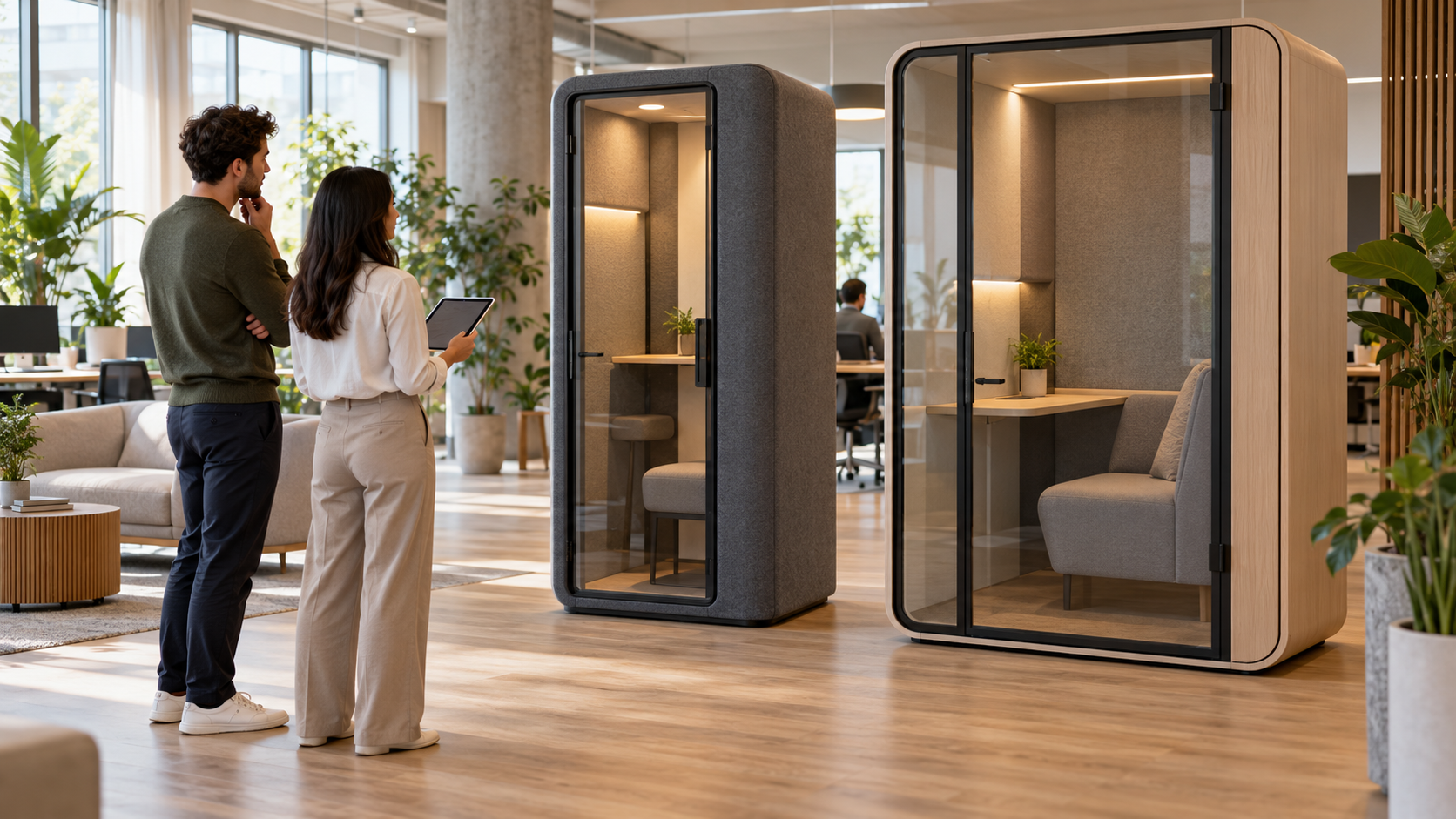
Buying an office phone booth is easier when the decision starts with the work it needs to support—not a glossy product page or a single headline figure. The right model should make private calls, video meetings, focused work, or small-group conversations more workable in the actual office where it will sit. This field guide gives workplace decision-makers a repeatable way to compare products across price bands while keeping evidence clear and trade-offs visible.
Start with the job, not the product category
“Phone booth,” “focus pod,” and “meeting pod” are useful labels, but they can hide important differences. Begin with a short use-case statement: who will use the pod, for what activity, how long at a time, and how often? A booth for ten-minute private calls has different requirements from a pod intended for laptop work throughout the day. A two- to four-person room needs a different layout, door clearance, and power setup than a one-person booth.
Then consider where the pod will sit. Look at circulation space, nearby desks, sight lines, flooring, ceiling height, access routes, and the intended electrical connection. A product can fit within the room dimensions yet still create an awkward route, block daylight, or be difficult to install. Treat the published footprint as a starting point, then plan the surrounding space people need to enter, exit, and work comfortably.
Compare published prices on the same basis
A displayed U.S. price is useful, but it is not automatically a project budget. Note whether it is a starting price, a configured price, or a quote-only product. Then list what the figure does and does not cover: delivery, installation, tax, accessories, furniture, power options, and site preparation. A less expensive booth may remain the better choice, but only after comparable items are put on the same worksheet.
It also helps to separate capital cost from operating friction. Ask what happens if the booth needs to move floors, relocate to another office, or be reconfigured later. Consider warranty terms, replacement parts, maintenance access, and whether the model can be self-assembled or requires professional installation. These are practical ownership questions, not secondary details.

Read acoustic information as evidence, not a scorecard
Acoustic claims are often the most eye-catching part of a comparison, and the easiest to oversimplify. A number by itself does not show whether two models were tested in the same way, under the same method, or against the same standard. For a like-for-like comparison, check exactly how the result is described and whether the manufacturer identifies the test method.
Only acoustic rating results tested according to ISO 23351-1:2020 can be objectively compared across models. Where a product shows a self-reported decibel-reduction figure, record it as published information rather than treating it as equivalent to an ISO-tested class. That does not mean the product cannot be suitable; it means the evidence should be read with context. If acoustic privacy is central, ask the supplier for the underlying test report and clarify what result is being reported.
Test the interior experience against the real workflow
Capacity alone is not a reliable guide to usability. For a solo pod, check whether there is enough room for a person, chair, laptop, bag, and normal movement. For a meeting pod, think about seating, screen placement, table depth, camera framing, and whether people can enter and leave without interrupting everyone else. Lighting, ventilation, power, and cable management are fundamental to a productive experience, especially where pods will be used repeatedly throughout the day.
If possible, arrange a demonstration or visit a reference installation. A short test should include the activities people will actually perform: a phone call, a video meeting, quiet laptop work, and a conversation outside the booth while someone is inside. Invite representative users, including people with different heights and accessibility needs. Capture feedback in the same format for every shortlisted product.
Make delivery and installation part of the decision
Lead time can affect a workplace project as much as the specification. Confirm the stated lead time for the configuration you want, rather than relying on a general estimate. Then check responsibility for delivery, floor protection, access constraints, assembly, electrical connection, and packaging removal. A clear installation plan reduces last-minute cost and avoids a pod arriving before the space is ready.
Finally, record the conditions under which the manufacturer’s warranty applies. A strong decision record includes selected configuration, price basis, acoustic evidence, dimensions, lead time, delivery and installation assumptions, warranty, and open questions. This turns a complicated purchasing discussion into a transparent comparison that can be reviewed later.